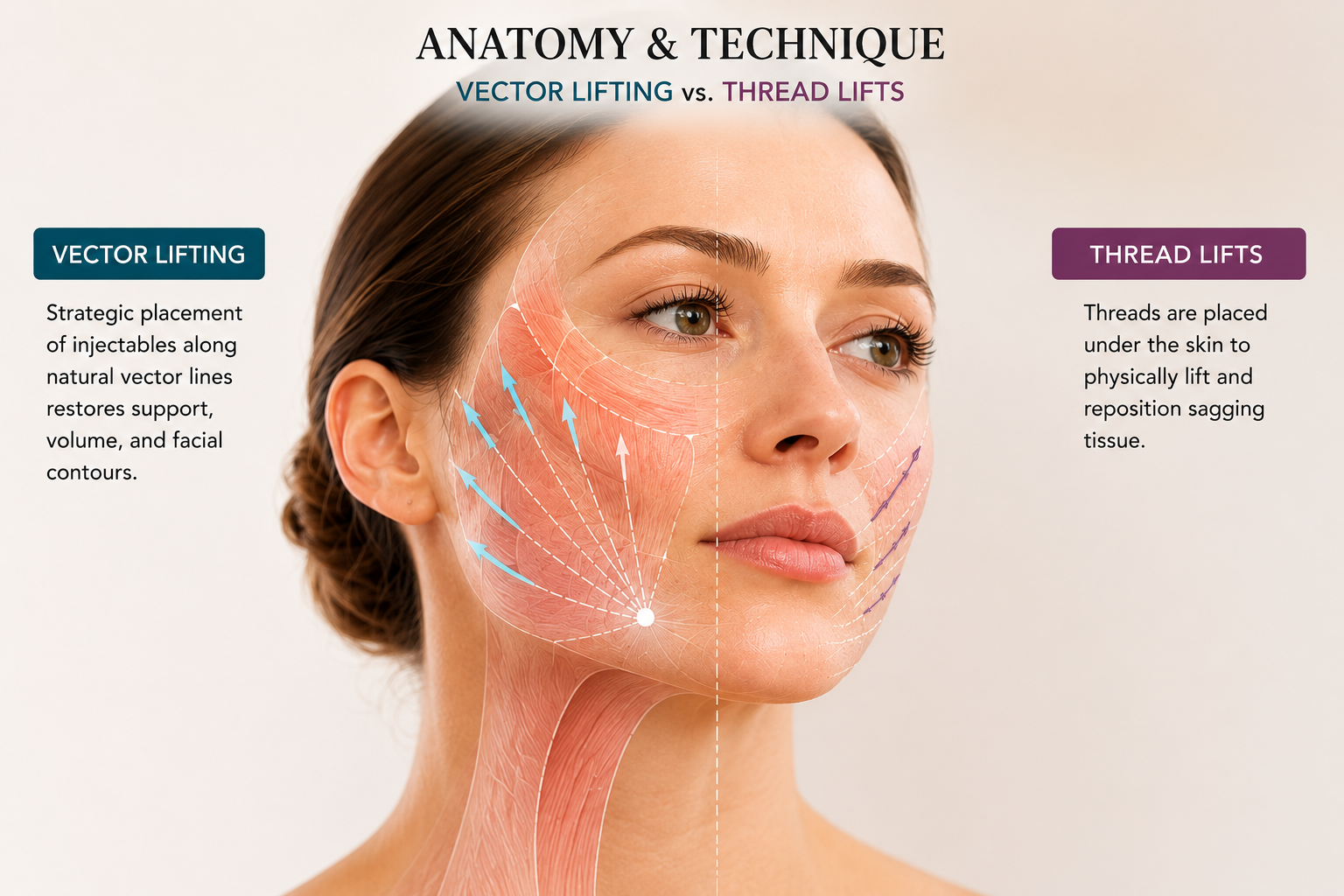
Facial lifting no longer automatically means surgery. Minimally invasive treatments can now improve facial contours, restore structural support, and address early signs of sagging without the recovery associated with a surgical facelift. Two approaches that may come up when researching these options are vector lifting and thread lifts. Although both are intended to create a more lifted appearance, the mechanisms behind them are substantially different.
Thread lifts rely primarily on absorbable sutures placed beneath the skin to reposition soft tissue. Vector lifting, depending on the specific treatment protocol, uses injectable products strategically placed along facial support vectors to restore volume and improve the structural relationships between different regions of the face. The difference between mechanical repositioning and injectable structural support affects not only the appearance of the result but also how it develops and how long it may remain visible.
Longevity is therefore more complicated than identifying which procedure has the higher number of months attached to it. The patient’s age, skin quality, degree of laxity, treatment area, materials used, and ongoing facial aging all influence durability. A treatment that performs well for mild cheek descent may not be appropriate for someone with significant lower-face laxity.
Understanding these distinctions can make it easier to compare vector lifting with other minimally invasive facial rejuvenation options. The most appropriate choice ultimately depends on whether the primary concern is loss of structural volume, tissue descent, skin laxity, or a combination of these changes.
How Vector Lifting and Thread Lifts Work
Vector lifting and thread lifting share a similar aesthetic objective: improving facial contours without conventional facelift surgery. Their similarity largely ends there. The procedures use different materials and interact with facial tissue differently, which affects the type of correction they can provide.
This distinction is particularly important when comparing longevity. A thread lift initially depends on mechanical support from implanted sutures, whereas an injectable vector-based treatment depends on strategic structural correction and the behavior of the injectable material used. Neither approach permanently stops the underlying processes responsible for facial aging.
How Vector Lifting Creates Structural Support
Vector lifting is based on the principle that facial aging occurs along predictable anatomical patterns. Volume decreases in some areas, retaining ligaments become less supportive, and soft tissues may gradually shift downward. Instead of treating every visible fold directly, vector-based injectable treatment targets selected support points that can influence the contours of neighboring facial regions.
For example, age-related changes in the midface can contribute to flatter cheeks, deeper nasolabial folds, and a heavier appearance in the lower face. Strategic restoration of support in the cheek region may therefore improve more than the injection site itself. The objective is not simply to fill individual wrinkles but to restore structural relationships between facial areas.
The products used in an injectable lifting strategy also matter. Hyaluronic acid fillers provide physical volume and support immediately, while collagen-stimulating products work more gradually. Different formulations have different levels of firmness, elasticity, tissue integration, and expected persistence. Treatment longevity consequently depends partly on which material is selected and where it is placed.
Vector lifting should not be confused with a surgical facelift. Injectable products cannot remove excess skin or physically reposition deep facial tissues to the extent possible with surgery. The approach is generally more appropriate when volume depletion and mild to moderate contour changes contribute significantly to the aged appearance.
How Thread Lifts Reposition Facial Tissue
Thread lifting takes a more mechanical approach. During treatment, absorbable threads are inserted beneath the skin using needles or cannulas. Certain threads incorporate barbs, cones, or similar structures designed to engage soft tissue so that it can be repositioned along a selected direction.
The lifting effect can be visible soon after treatment because tissue is physically repositioned. The degree of correction depends on thread design, placement plane, facial anatomy, and the amount of tissue being lifted. Threads are commonly considered for areas such as the cheeks, jawline, brows, and lower face.
Materials used for absorbable threads can include polydioxanone, poly-L-lactic acid, or polycaprolactone. These materials gradually degrade after placement. Tissue remodeling and collagen formation may occur around the threads, but this biological response should be distinguished from the initial mechanical lifting effect.
Thread lifting also has anatomical limitations. Heavy tissue, substantial skin excess, and advanced laxity cannot necessarily be corrected predictably with additional threads. Trying to achieve a surgical degree of lifting with a minimally invasive technique may lead to unrealistic expectations.
Why the Difference Matters for Longevity
Longevity depends partly on what is producing the visible improvement. With thread lifts, the immediate result comes primarily from mechanical repositioning. As the threads gradually lose structural integrity and the face continues to age, some of that initial correction can diminish.
Vector lifting follows a different pattern. When hyaluronic acid filler is used, the structural effect gradually decreases as the material is metabolized. When a biostimulatory injectable is incorporated into a treatment strategy, improvement may develop more slowly because collagen remodeling contributes to the result.
Facial movement also affects durability. Products placed in highly mobile areas may behave differently from materials positioned against relatively stable structural regions. Metabolism, injection depth, product properties, and the amount used create additional variation between patients.
For that reason, claims that either vector lifting or thread lifting always lasts a specific number of months should be interpreted cautiously. Expected duration is better discussed as a range based on the exact technique and material rather than as a guaranteed endpoint.
Vector Lifting vs. Thread Lifts: Which Lasts Longer?
There is no universal answer to whether vector lifting or thread lifting lasts longer because “vector lifting” can involve different injectable products, while thread-lift durability varies according to thread material and technique. In appropriate patients, either treatment can provide a meaningful temporary improvement. The more useful comparison considers how the result changes over time and what type of aging each procedure is intended to correct.
A longer-lasting treatment is also not automatically the better treatment. If the underlying concern is primarily volume depletion, repositioning tissue with threads may not address the actual problem. Conversely, adding injectable support cannot fully compensate for substantial loose skin or advanced tissue descent.
Expected Longevity of Vector Lifting
The duration of vector lifting is strongly influenced by the injectable selected for treatment. Hyaluronic acid fillers can remain clinically noticeable for months and, depending on the product and treatment location, sometimes considerably longer. Areas with less movement and products designed for structural support generally behave differently from softer fillers used in highly mobile facial regions.
Collagen-stimulating injectables introduce another timeline. Instead of depending exclusively on the persistence of a gel, these products encourage gradual tissue remodeling. Patients considering this type of approach may also review Sculptra treatment to understand how collagen biostimulation differs from conventional volumizing fillers.
The amount of correction required is another factor. A patient with mild midface deflation may maintain an aesthetically satisfactory result longer than someone experiencing continued rapid volume loss or significant age-related changes. Weight fluctuations can also alter facial proportions independently of the injectable.
Maintenance is therefore usually based on clinical changes rather than a fixed calendar date. Periodic assessment can identify where support has diminished and whether a conservative touch-up is preferable to repeating the original treatment plan in full.
Expected Longevity of Thread Lifts
Thread-lift results are temporary because absorbable threads eventually degrade and facial aging continues. Published duration estimates vary considerably because multiple thread materials, configurations, and treatment techniques are grouped under the general term “thread lift.” The patient’s tissue quality and the degree of correction also have a major influence on how long the visible lifting effect persists.
An immediate improvement may be noticeable after placement, followed by changes as swelling resolves and the threads settle. Over subsequent months, the mechanical contribution of the threads decreases. Collagen formed around the treatment area may provide some continuing tissue support, but it does not transform a thread lift into a permanent facelift.
Patients with relatively mild laxity and good skin elasticity tend to be more appropriate candidates than those with heavy lower-face tissue or substantial excess skin. If the tissue places excessive load on the threads, the visible correction may be less pronounced or may diminish sooner than expected.
Repeated thread procedures are possible in selected patients, but maintenance should not be approached simply by continually adding more threads. Facial anatomy, existing material, scar tissue, and changes from previous procedures need to be considered before additional treatment.
Longevity Comparison at a Glance
| Factor | Vector Lifting | Thread Lift |
|---|---|---|
| Primary mechanism | Injectable structural support | Mechanical tissue repositioning |
| Initial effect | Often immediate with filler | Usually immediate |
| Collagen stimulation | Depends on product | May occur around threads |
| Duration | Product and area dependent | Thread and technique dependent |
| Maintenance | Injectable touch-ups may be used | Repeat treatment may be considered |
| Best suited to | Volume-related structural changes and mild contour descent | Mild to moderate tissue descent |
| Permanent | No | No |
The practical difference is that injectable vector lifting can be adjusted according to how individual facial compartments change, while thread lifting provides temporary mechanical repositioning along selected directions. Which lasts longer for a particular patient depends on the materials used and the anatomical problem being treated.
Which Treatment Produces the Most Natural-Looking Lift?
Longevity is only one measure of treatment success. A result that persists longer but changes facial proportions in an undesirable way is not necessarily preferable to a shorter-lasting treatment that addresses the underlying anatomy more accurately. Natural-looking facial rejuvenation depends on maintaining proportion, movement, and appropriate transitions between treated and untreated areas.
Both vector lifting and thread lifts can appear natural in appropriately selected patients. Problems are more likely when either procedure is expected to correct anatomical changes beyond its capabilities or when treatment is excessive.
Vector Lifting and Facial Proportions
Vector lifting can create subtle changes because injectable support can be distributed across several anatomical points rather than concentrated in a single visible area. Restoring cheek support, for example, may improve the transition between the midface and lower face without directly filling every line.
This approach can be particularly useful when apparent sagging is partly caused by volume depletion. Restoring lost structural support may soften facial folds and improve contour while preserving the patient’s existing features.
Product selection remains critical. A filler appropriate for structural cheek support may not be suitable for a superficial or highly mobile region. Understanding differences among dermal filler treatments helps explain why injectable lifting cannot be reduced to simply placing more filler into the face.
Overcorrection is possible. Excessive filler can create heaviness, distorted proportions, or an overfilled appearance. Conservative volume restoration based on facial anatomy is therefore central to achieving a natural result.
Thread Lifts and Immediate Repositioning
Thread lifts can produce an immediately visible change because the treatment physically redirects soft tissue. For patients with early tissue descent and adequate skin elasticity, this may create a subtle improvement in cheek position or jawline definition without substantially changing facial volume.
The direction and tension of thread placement are important. Excessive tension can temporarily produce puckering, dimpling, or an unnatural pulled appearance. Some early irregularities may improve as swelling resolves and tissues settle, but careful technique is essential.
Threads also do not restore volume that has disappeared with age. A patient with both tissue descent and substantial facial hollowing may therefore appear lifted but still depleted after a thread-only procedure. In these circumstances, an injectable treatment or another rejuvenation method may be needed to address the additional component.
The most natural result comes from matching the procedure to the anatomy rather than selecting a treatment solely because it provides an immediate lifting effect.
When Combination Treatment May Be Appropriate
Facial aging rarely results from one process. Volume depletion, collagen loss, ligament changes, repetitive muscle activity, and skin laxity can occur simultaneously. A patient may consequently require different treatments for different concerns.
Injectable structural support can be combined with treatments designed to improve skin quality or collagen production. Neuromodulators may address dynamic wrinkles, while energy-based or microneedling treatments can target skin texture and laxity. The objective is to avoid forcing one procedure to perform functions for which it was not designed.
Combination treatment does not necessarily mean performing every procedure during the same appointment. Staging treatments can allow swelling to resolve and make it easier to evaluate the effect of each intervention before additional correction is performed.
This approach also supports conservative treatment. Instead of using excessive filler or aggressive thread tension to obtain a larger change, several complementary techniques can address separate components of facial aging.
Safety, Recovery, and Treatment Considerations
Both vector lifting and thread lifting are minimally invasive compared with facial surgery, but neither is risk-free. The procedures involve different materials and techniques, so their potential complications and recovery characteristics also differ. These factors should be considered alongside longevity when comparing treatment options.
Injector experience and anatomical knowledge are particularly important for procedures involving facial blood vessels, nerves, and deeper tissue planes. A consultation should include discussion of expected benefits, limitations, alternatives, and complications relevant to the proposed technique.
Recovery After Vector Lifting
Recovery following injectable vector lifting is generally similar to recovery after other facial injectable procedures. Temporary swelling, tenderness, redness, and bruising may occur around treatment sites. The extent of these effects depends on the product, areas treated, injection technique, and individual healing response.
More significant complications are possible with injectable fillers. Inadvertent injection into or compression of a blood vessel can compromise circulation, making vascular occlusion a rare but serious concern. Infection, nodules, asymmetry, and unwanted product placement are additional considerations.
Some injectable materials can be reversed while others cannot. Hyaluronic acid filler can generally be dissolved with hyaluronidase when clinically appropriate, whereas collagen-stimulating products require different management strategies. This difference should be considered when choosing a product for structural facial correction.
Patients should follow individualized aftercare recommendations and contact their provider promptly if they develop severe or increasing pain, unusual skin discoloration, visual symptoms, or other unexpected changes.
Recovery After Thread Lifting
Thread lifting commonly produces swelling, bruising, tenderness, and a sensation of tightness during early recovery. Temporary dimpling or puckering can occur where tissue has been repositioned. Patients may also be advised to limit exaggerated facial movement and pressure on treated regions while the threads stabilize.
Thread-specific complications can include palpable or visible threads, asymmetry, extrusion, infection, irregular contours, and loss of the initial lifting effect. Although absorbable threads eventually degrade, complications may still require clinical management before that process is complete.
The procedure creates pathways beneath the skin, so sterile technique and appropriate placement depth are important. Thread position also needs to account for facial movement and underlying anatomical structures.
Patients should understand that “minimally invasive” does not mean without recovery. Planning adequate healing time is particularly important before weddings, photography, travel, or other major events.
Who May Be a Better Candidate for Each Treatment?
Vector lifting may be particularly relevant when loss of facial support is strongly associated with declining volume. Flattened cheeks, changes in facial proportions, and mild lower-face descent related to structural depletion may respond well to strategically positioned injectable products.
Thread lifting may be considered when soft-tissue descent is more prominent than volume loss and skin retains enough elasticity to accommodate repositioning. Patients seeking a modest mechanical lift without surgery may find the approach appropriate after a professional assessment.
Neither option is an equivalent replacement for facelift surgery in patients with substantial skin excess or advanced facial laxity. Surgical consultation may provide a more predictable correction when the anatomical changes exceed what minimally invasive procedures can reasonably achieve.
Medical history, previous injectables or threads, medications, skin condition, and expectations should all be reviewed before treatment. Appropriate candidate selection has a direct effect on both safety and longevity.
Vector Lifting at U Clinic Miami
Choosing between vector lifting and thread lifting begins with identifying why facial contours have changed. Visible sagging may result from volume depletion, tissue descent, declining skin elasticity, or several of these factors occurring together. Treating the visible symptom without identifying its anatomical cause can lead to unnecessary product use or disappointing longevity.
U Clinic Miami offers vector lifting for patients whose facial assessment indicates that strategic injectable support may improve contour and balance. Treatment planning considers facial proportions, existing volume, tissue quality, previous procedures, and the areas in which structural support has diminished.
Developing an Individualized Facial Lifting Plan
An effective lifting plan begins with examination of the entire face rather than an isolated wrinkle or fold. Midface support, cheek projection, temple volume, chin proportions, jawline structure, and skin laxity can all influence how facial aging appears.
Treatment can then be directed toward the anatomical changes that contribute most strongly to the patient’s concerns. Some patients may benefit primarily from injectable structural support, while others may need collagen stimulation or skin-focused procedures.
A conservative approach is particularly important with facial injectables. The objective is to improve support and proportion without creating excessive fullness. Results should remain compatible with natural facial movement and the patient’s underlying bone structure.
Patients can also review the broader range of facial procedures when considering how lifting, volume restoration, and skin rejuvenation may fit into a longer-term aesthetic strategy.
Planning for Longevity Rather Than Maximum Correction
Long-term aesthetic planning does not require maximizing the amount of correction during a single session. Facial aging continues after any nonsurgical procedure, and treatment should account for how proportions are likely to change over time.
Periodic assessment makes it possible to identify where structural support is decreasing before performing additional treatment. Small adjustments may preserve facial balance more effectively than waiting for a result to disappear completely and then repeating an extensive correction.
Longevity should also be considered alongside product behavior. A longer-lasting injectable is not necessarily appropriate for every facial region, just as a stronger mechanical thread lift is not automatically better for every patient. Material characteristics need to match anatomy and treatment objectives.
A personalized consultation can establish realistic expectations about the anticipated degree of lifting, recovery, maintenance, and alternatives before a procedure is selected.
Choosing Between Vector Lifting and Thread Lifts
The central difference between vector lifting and thread lifting is the mechanism of correction. Vector lifting uses strategic injectable placement to restore structural support and facial proportions. Thread lifting mechanically repositions selected soft tissues using absorbable sutures.
Patients whose apparent sagging is substantially related to volume depletion may be better suited to vector-based injectable treatment. Patients with mild tissue descent but relatively preserved facial volume may be more appropriate candidates for threads. Some individuals have both concerns and require a broader treatment strategy.
The decision should therefore not be based exclusively on which treatment lasts longer. The procedure that accurately addresses the underlying anatomical change is more likely to produce a satisfactory result throughout its lifespan.
Which Lasts Longer: Vector Lifting or Thread Lifting?
Neither vector lifting nor thread lifting provides permanent facial rejuvenation. Thread lifts offer temporary mechanical repositioning, while the duration of vector lifting depends largely on the injectable products used, treatment location, patient metabolism, and whether collagen stimulation contributes to the result. Individual longevity can therefore vary substantially with either procedure.
Vector lifting may offer an advantage when the primary problem is facial volume depletion because treatment can restore support at selected anatomical points and can be maintained through targeted injectable adjustments. Thread lifts may provide a more immediate repositioning effect for appropriately selected patients with early tissue descent, but the mechanical lift diminishes as the threads degrade and facial aging continues.
The more meaningful question is not simply which procedure remains visible for the greatest number of months. Treatment should match the cause and severity of facial aging, provide an acceptable safety profile, and preserve natural facial proportions throughout the treatment period.
A professional facial assessment can determine whether volume restoration, mechanical repositioning, collagen stimulation, skin tightening, or a combination of techniques is most appropriate. When treatment is selected according to anatomy rather than longevity alone, both the immediate result and long-term maintenance strategy become more predictable.